
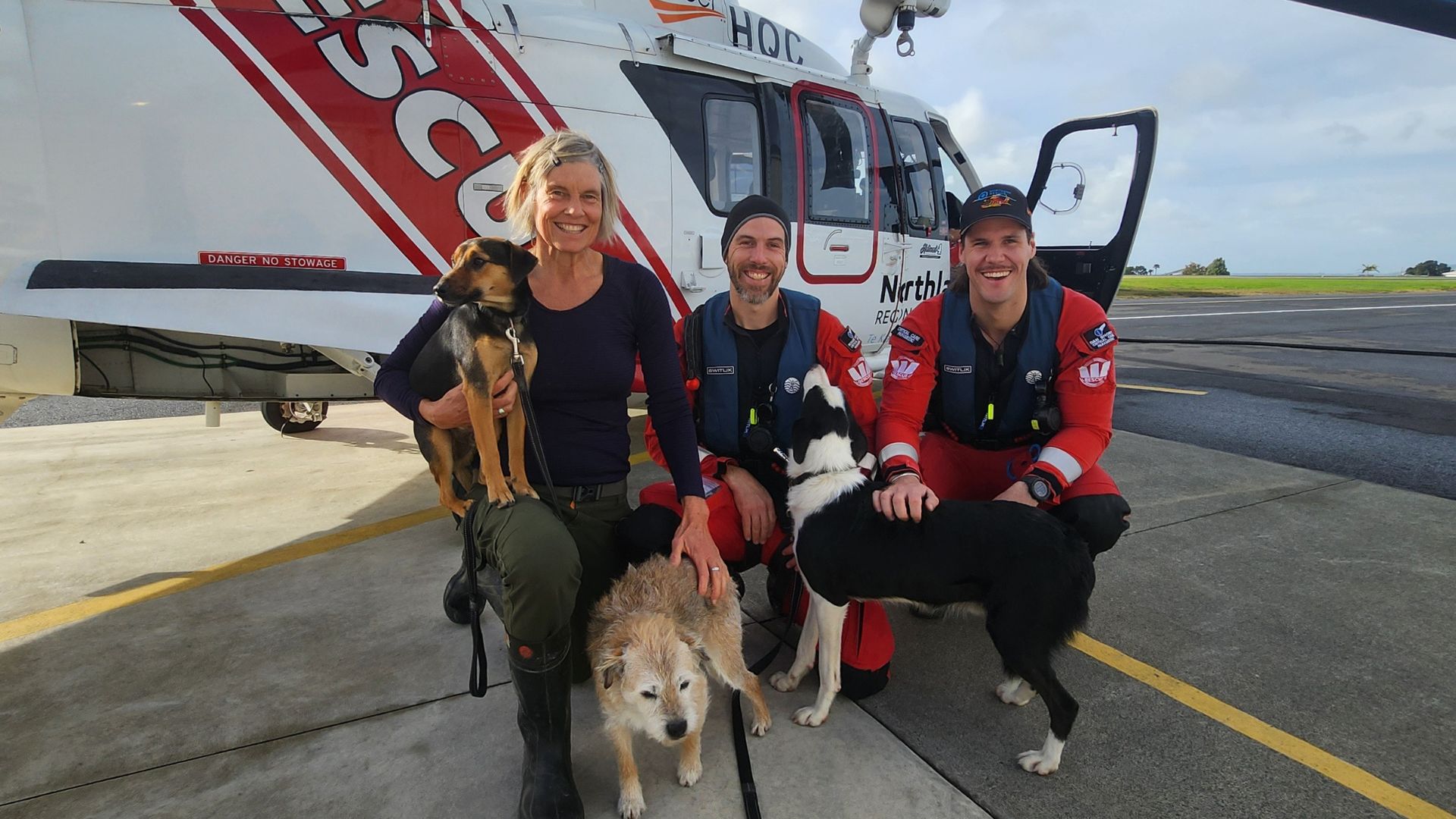
Dog rescue all part of the service
Miriam Ritchie is normally the one doing the saving – well of the environment anyway.
That role was reversed in April 2026 when she needed to be winched off the Hen and Chickens by a Northern Rescue Helicopter after a heavy fall left her with five broken ribs.
Miriam injured herself after falling in steep terrain while undertaking her work for DOC with her rodent detection dog ‘Ahu’. A trip back to the mainland was quickly ruled out as the impact of the rough seas would be too painful on her ribs, so her colleague decided she should stay put.
A Northern Rescue Helicopter was tasked with the retrieval mission and arrived before dusk. Critical care paramedic Dan Short was winched on to the Island and first attended to ‘Ahu’.
Miriam’s little mate was secured in a winch retrieval device called a child/animal rescue bag (CARB), especially designed for children and animals. It quite possibly is Northern Rescue’s first dog retrieval ever!
Thanks to the Northern Rescue crew, which also comprised of Johs Van Pierce (captain), Marinus Coetzee (co-pilot) and Richard Sharp (hoist operator and critical care paramedic), Miriam was safely and comfortably flown back to the Northern Rescue base and transported by ambulance to Whangārei Hospital for a check-up.
“The crew was awesome. We’re very lucky to have such an amazing service with such highly skilled people, available to us,” says Miriam.
“The crew were so friendly and they clearly enjoyed their work. I felt embarrassed they came to get me because I only had broken ribs but they assured me they loved exciting rescues involving winching people and rescuing dogs, which made me feel much better.”
Miriam says she is well aware of Northern Rescue’s work as her job is relatively high risk in remote or hard to get to places.
“The potential for helicopter rescue is always there, so I am always aware and grateful for what they do and I will certainly be donating after this experience.”
At the time of her accident she was camping out on Taranga/Hen Island of the Hen and Chicken group camping and carrying out DOC’s annual rodent surveillance checks with Ahu to ensure no rats or mice have been transported out to the islands on boats over summer.
“We were on our fourth day of work and returning to camp on a track that is steep and sheer and very slippery because of all the rain we’ve had this summer. I was nearly back, on a particularly steep bit and I simply slipped – my foot went out from under me and I must have done a little twist/flip because I landed on a rock with my left ribs landing very heavily.
“I heard an ominous and horrible crunch and I skidded to a stop in a pile below the rock. I was winded, very sore, swore a lot and told myself to breath while I sat there assessing my condition and determining exactly where the pain was.
“Back at camp I remained very uncomfortable, unable to sit down or bend over without considerable pain. I was also a bit breathless so I was relieved I wouldn’t have to row out to a rescue boat in the dark when the decision was made to send the helicopter, as the whole thing would have been very painful.
“The chopper came about half an hour later after I had alerted to my colleagues of my likely injuries.
“I could see they were looking for my camp under the bush canopy(I’d given the GPS co-ordinates so they knew approximately where we were) so I put my hi-vis vest on and put my other one on top of my tent which was in a small clearing, so they could see us.
“They hovered and Dan was winched down through the bush about 50 metres away. He walked over to me and was communicating to the chopper on his headset. He introduced himself, met Ahu and said he was going to need to take Ahu up first (assuring me he would not drop him).
“Then Dan came back down to get me. The trip up to the chopper was amazing. We were pulled up through the canopy of Pohutukawa then up through the dusk light with the end of the sunset in the distance, and I could see the cliffs beside us and Sail Rock out to the South.
“We seemed to go up and up and up before we got to the chopper. The crew and pilot were all chatting with me which was nice and relaxing and made me forget my pain for a while. We mostly talked about our dogs and I was impressed when the pilot told me he had tried out the lift bag with his own heading dog.
“It is amazing to think public donations go towards buying a piece of gear like the CARB (child/animal rescue bag) to help people like me in their time of need and I was the first person to need it in a rescue situation!” laughs Miriam.
Miriam runs Canine Conservation and is a pest detection dog trainer, certifier and handler contracting to the NZ Conservation Dogs Programme, which is administered by DOC. She has rodent (rats and mice) and mustelid (weasel, stoat and ferret) detection dogs and mostly works on offshore islands around NZ and sometimes overseas.
Most of her work is carrying out surveillance of NZ’s pest-free island sanctuaries with her dogs to make sure no invading rodents or mustelids have got to our islands. She also responds to incursions, so if a pest has got to an island sanctuary, she tries to locate the animal to guide capture and removal – and also checks islands after large-scale pest eradication projects.


