
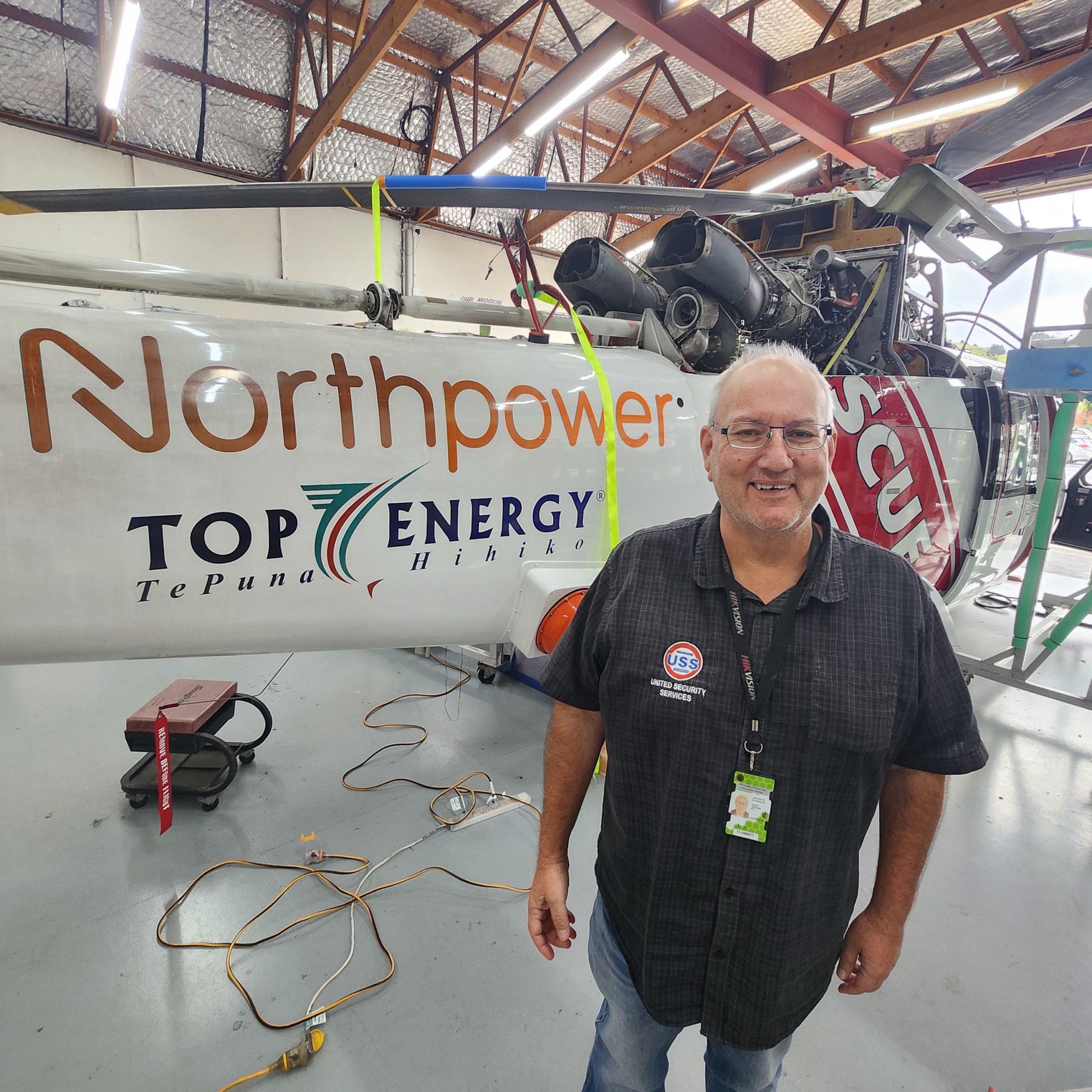
It has been almost three decades since Doug Shearer earned a flight in a Northland Rescue Helicopter but his memory of the days that followed is acutely accurate all these years later.
Doug made a near fatal mistake diving one day when he went against the best practice he had learnt in training.
He got overly excited he says and did three deep dives in a row.
“Normal dive profiles for best practice would start with the deepest dive first and the shallow dive next. But I did three dives at 40-plus metres and during my third and deepest dive I was bagging some big crays, looked at my gauge and there was only 50 bar left,” recollects Doug.
Realising he could be in trouble if he didn’t act quickly, Doug aborted his dive and began his normal ascent rate.
“I got to the decompression stop and basically took a couple of breathes and there was no more air left, so I had to surface the final five metres immediately. I had my underwater scooter with me and got back to the boat, handed my scooter up, took my weight belt off and handed it in.”
At that point Doug lost his balance in the water and fell sideways. He was helped into the boat where he sat shivering.
“Everything was too bright. I had to cover my head and had massive nausea but I was not even thinking about the bends. We got back to Parua Bay 35 minutes later and I had lost the numb, drunk feeling and felt much better so I stupidly did nothing about it.”
A couple of days later Doug was climbing a small step ladder, lost his balance and fell off.
“I was a dive master for the Dive Connection so I called the owner, Peter Hope. We both thought I was just fatigued but we called Dr Peter Chapman-Smith – ‘the dive doctor’.
“We went to his practice in Maunu Road. He did an exercise where I put one foot in front of the other, crossed my arms to my shoulders and closed my eyes. I fell straight to the ground. He put a call into the hyperbaric chamber at the Devonport Naval Base immediately.
“The folk at the Naval Base said I had to get there now.”
The next question was how, as an ambulance was not an option with the crown of the Brynderwyns being over 1000 feet and the risk of bubbles forming in the blood stream which can cause death.
The Whangārei-based Northland Rescue Helicopter was the only option and Doug was soon on a flight from Whangārei at a safe altitude of 500 feet.
He spent a week in hospital at the Devonport Naval Base.
“I had two trips to the hyperbaric chamber. I was pressurised to 18 metres (the depth of a normal recreational dive) and did the standing test and fell over. At that point they put me on mixed gases and proceeded to take me to 36 metres. It was like someone had lifted the veil and I asked the doctor if we could get out of there,” says Doug.
The doctor said yes – six hours later.
A few days later Doug had another 18-metre ‘trip’ before driving home.
“A few months later I was watching a friend doing the Kerikeri half marathon and all of a sudden, my hands were tingling, so I hit the road and was back to Devonport for another 18-metre experience.
“Once you have the bends you have nitrogen in your body for the rest of your life. I had a break for two years, did about another ten dives and lost the passion after completing thousands of dives in my time.
“Without the Northern Rescue Helicopter ride I would have died from bubbles forming in my blood stream. Getting me to that critical treatment was a second to none service in my mind, yet I had never thought of the Northland Rescue Helicopters before that!
“I am so grateful for the service and the people involved – they are all so selfless and care so much for people. Since my trip I have been reminded time and again how valuable it was for me and is for others.”


